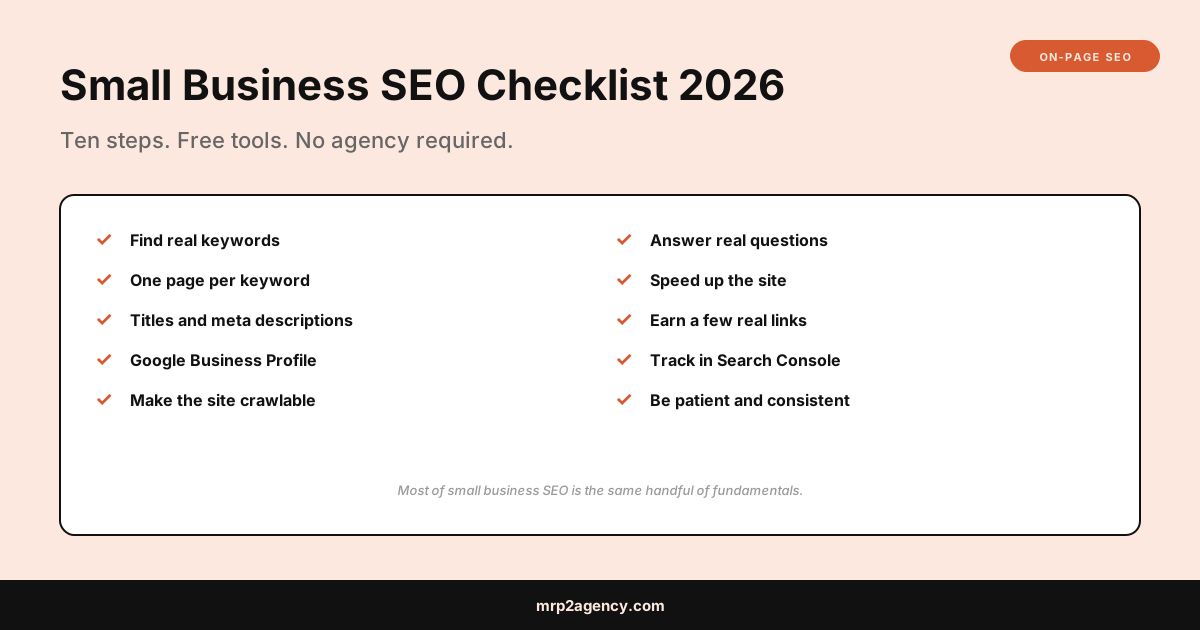
I run a version of this for every client. The dirty secret of the industry is that 80% of small business SEO is the same handful of fundamentals, and most local competitors haven’t done them. Do the fundamentals well and you’re already ahead of the businesses paying a retainer for monthly “SEO reports” nobody reads.
Here’s the whole list, plain English, no jargon.
1. Find the Keywords People Actually Type
Before anything else, figure out what your customers search. Not what you call your service, what they call it. A “HVAC contractor” might need to rank for “AC repair near me.”
Use Google Keyword Planner (free with a Google Ads account) and Google’s own autocomplete. Type your service into the search bar and read the suggestions. Those are real queries. Write down ten to twenty that match what you actually do, then move on. Do not overthink this step.
2. Set One Page Per Important Keyword
Each main service you offer gets its own dedicated page targeting one primary keyword. A plumber needs separate pages for “drain cleaning,” “water heater repair,” and “emergency plumbing,” not one “Services” page trying to rank for all three.
Google ranks pages, not websites. One focused page per topic beats one bloated page every time. This is the structural decision that quietly determines whether the rest of your effort works.
3. Write Real Titles and Meta Descriptions
Every page needs a title tag and meta description written for humans who are about to click.
- Title tag: 50 to 60 characters, primary keyword near the front, your city if you’re local. Example: “Drain Cleaning in Kansas City | Acme Plumbing”
- Meta description: 150 to 160 characters that make someone want to click. This doesn’t directly affect ranking, but it heavily affects whether people click your result over the one above it.
This is the highest-leverage hour of work on this entire list. It’s also the one most small sites get wrong with empty or duplicate tags.
4. Claim and Optimize Google Business Profile
For any business with local customers, Google Business Profile is the single biggest lever. It’s free, and it controls whether you show up in the map pack and on the right side of search.
Fill out everything: hours, services, service areas, photos, and your exact business category. Then actually ask happy customers for reviews and respond to them. I go deep on the local side of this in the local SEO checklist for service businesses, but even just completing the profile fully puts you ahead of most competitors.
5. Make Sure Google Can Read Your Site
If Google can’t crawl your pages, nothing else matters. The basics:
- Your site is on HTTPS (the padlock in the browser)
- You have an XML sitemap submitted in Google Search Console
- Your
robots.txtisn’t accidentally blocking your own pages - Each page has one clear H1 that matches its topic
This is the lightweight version of a full technical pass. If you want the complete process, my technical SEO audit checklist is the twelve-step version. For most small sites, the four checks above catch the real problems.
6. Write Content That Answers Real Questions
Google rewards pages that genuinely answer what someone searched. The most reliable way to do this is to write the answers to questions your customers actually ask you.
Every “how much does X cost,” “how long does Y take,” and “what’s the difference between A and B” is a blog post that can rank and bring in people early in their decision. The mechanics of doing this consistently are in how to start a small business blog. You don’t need to publish weekly. You need to answer real questions thoroughly.
7. Speed Up Your Site
A slow site ranks worse and converts worse, especially on mobile, which is what Google measures. Run your homepage through PageSpeed Insights, look at the mobile score, and fix the obvious wins:
- Compress oversized images (the most common single problem)
- Remove plugins and scripts you don’t use
- Make sure images have set dimensions so the page doesn’t jump as it loads
You’re aiming for a mobile score of 90 or above. Most small business sites start in the 40s and 50s, so there’s usually a lot of easy ground to gain.
8. Earn a Few Real Links
Links from other sites still signal trust to Google. You don’t need hundreds. For a local business, a handful of quality local links beats a pile of junk.
Get listed in your local chamber of commerce, relevant local directories, and any organization you sponsor or belong to. If you do good work, ask satisfied partners and suppliers to link to you. Ignore anyone emailing you to “buy 5,000 backlinks.” That’s how you get penalized, not ranked.
9. Track It in Google Search Console
Google Search Console is free and tells you exactly what Google thinks of your site: which queries you show up for, what’s getting clicked, and any crawl problems.
Check it monthly. Look at which pages are gaining impressions, which queries you rank on page two for (those are your easiest wins to push to page one), and fix anything flagged under the Pages report. This is the entire “SEO reporting” function an agency would charge you for.
10. Be Patient and Consistent
This is the step everyone skips, so let’s make it explicit. SEO is not a launch, it’s a slow compounding effect. The pages you fix today start earning weeks or months later, and the businesses that win are the ones that did the fundamentals and then left them alone to work instead of tearing everything up after three impatient weeks.
How Long Does SEO Take for a New Site
For a brand-new site, expect three to six months before you see meaningful movement, and closer to six to twelve before you’re competitive on anything valuable. For an established site with some history, fixing the fundamentals above can show results in as little as four to eight weeks.
That timeline is exactly why the agency retainer model is a tough deal for small businesses: you pay every month from day one, but results are back-loaded. Doing the fundamentals yourself means the only thing you’ve spent during that waiting period is your own time.
DIY SEO for Small Business: What to Skip
Knowing what to ignore saves as much money as knowing what to do. For a small business, skip these:
- Expensive all-in-one SEO suites. The free Google tools cover what you need at your scale.
- Chasing hundreds of keywords. Pick the ten to twenty that matter and do them well.
- Daily content churn. Quality over volume. One genuinely useful page beats ten thin ones.
- Technical rabbit holes. Once the basics in step 5 are handled, stop. Diminishing returns kick in fast.
What This Means for You
If you run a small business, here’s the honest takeaway: the fundamentals on this list are completely doable yourself, they cost nothing but time, and they’re most of the available results. Work down the ten steps in order, give it a few months, and check Search Console to see it working.
The point where it makes sense to hire help isn’t the basics, it’s when you’ve done them, you’re ranking, and you want to scale content or compete for harder terms. That’s a real reason to bring someone in. Paying a retainer to do the ten steps above is not.
Want a quick read on which of these ten your site is missing? Tell me about your project and I’ll tell you where your biggest wins are, even if the answer is that you’ve already got it handled.