Almost everything, as it turned out. But fixing it took a weekend, not a $20,000 marketing budget.
SEO for nonprofit websites and small youth organizations is its own discipline, and the standard agency advice doesn’t fit. You don’t have a marketing team. You don’t have an ad budget. You probably don’t even have a dedicated webmaster. Here’s what actually works when you’re a volunteer-run organization trying to get found by your own community.
Why These Sites Struggle
Most nonprofit and youth-org websites have the same five problems:
- A donated website built once and never touched. Some local marketing shop built it pro bono in 2018 and is no longer in business. The site looks fine but hasn’t been updated since.
- Content that’s all “About Us” and event flyers. Nothing search engines can index meaningfully.
- A platform that fights SEO. GoDaddy site builders, free Wix accounts, and abandoned WordPress installs all carry overhead the site can’t outgrow. The deeper hand-built versus page-builder argument applies extra hard for nonprofits, because you usually can’t afford to fix what you started on.
- No clear local signals. Google doesn’t know what city the org serves, what school it’s attached to, or what it actually does.
- Volunteer rotation. The person who knew the password left two years ago. Nobody can update anything without a help desk ticket.
If two or more of those describe your situation, the good news is that fixing each one takes hours, not months.
The Five SEO Moves That Move the Needle
Skip the deep technical SEO rabbit hole. For a nonprofit or booster site, do these five things in order. They cover 80% of what matters.
1. Tell Google what you do, in plain English, on the homepage
Your homepage <title> and <h1> should literally answer the question: who are you, what do you do, and where do you do it.
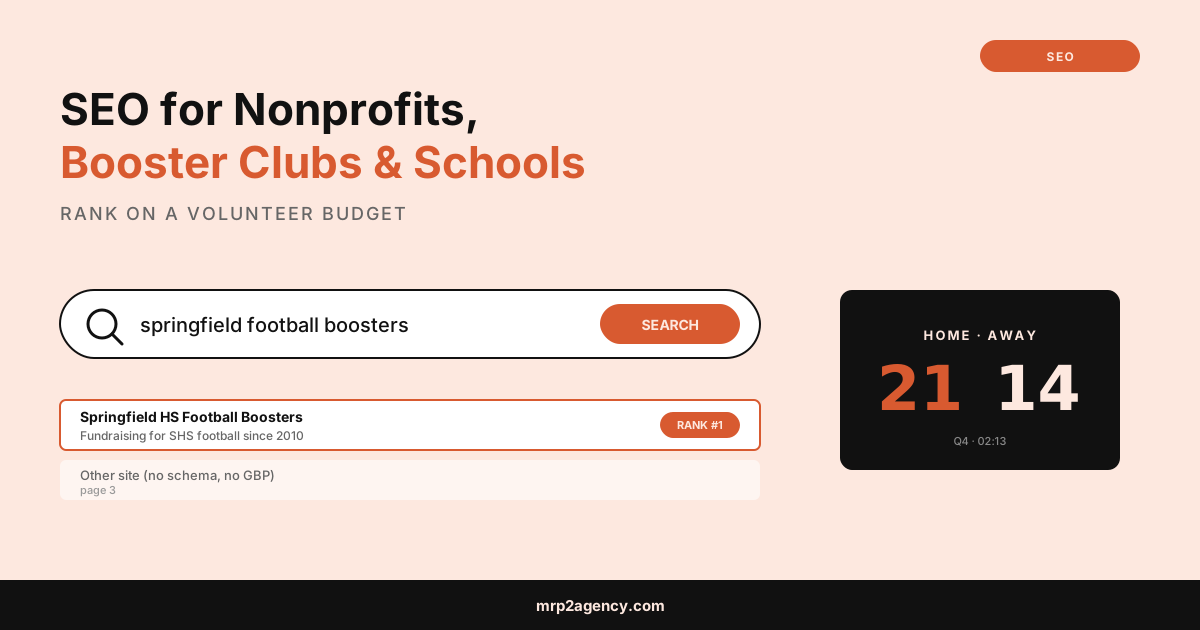
Bad: “Welcome to our website” Good: “Springfield High School Football Booster Club | Fundraising for SHS Football Since 2010”
That single tag change moves rankings within weeks for organizations with established backlinks (which most established nonprofits have, even if they don’t know it).
2. Set up Google Business Profile
This one is free, takes 20 minutes, and works specifically for booster clubs, school programs, churches, and 501(c)(3) organizations. Go to Google Business Profile and claim your listing. Add the address, hours (even if “by appointment”), photos, and your website URL.
Most ranking signals for “near me” and “[town] [activity]” searches come from this profile, not the website itself. Skipping this step is the single biggest mistake nonprofits make.
3. Write three pieces of content that answer real questions
You don’t need a blog. You need three pages, each answering a question your community actually searches.
Examples for a booster club:
- “How to donate to [school] athletics” with all donation methods on one page
- “[School] football schedule and tickets [year]”
- “[School] alumni resources and giving”
These pages will rank quickly because almost no one writes them. The competition is your school’s official athletic page (which is usually thin) and Wikipedia (which doesn’t have your city).
4. Get linked from your school district’s website
The single highest-value backlink for a school-affiliated org is from the school district’s website. Email the district webmaster, tell them you’re updating your site, and ask if they’d add your link to their boosters or partners page.
This works because school district domains are typically very high-authority and very rarely link out. One link from a .edu or a district .org is worth a hundred from random blogs.
5. Update something on the homepage every two months
Search engines weight freshness. A site that hasn’t been touched since 2022 ranks lower than a site updated last week, all else equal. You don’t have to write blog posts. You just have to update a date, swap a banner photo, change the upcoming events, or add a “thanks to our 2026 donors” section.
Calendar this for the volunteer rotation. Two minutes every two months is enough.
SEO for Nonprofit Websites: Local Specifics
For school athletic programs and youth orgs, local search is most of the game. Three specific moves:
- Schema markup for organization details. Add JSON-LD to your homepage with your organization name, address, phone, parent organization (the school), and area served. Schema.org’s Organization type has the full template.
- Be on Google Maps. This requires Google Business Profile (above) plus a verified address. Even if the org is “based out of the school,” use the school address.
- Get name-checked in local news. When local media covers your fundraiser, ask the reporter to link the org’s website in the online version. Most will. This is the cheapest way to build local authority.
A consistent visual presence helps too. The same logic that applies to brand identity for solo founders applies to small nonprofits: name, colors, type, and tone should be predictable across the website, the donation page, and any social profiles.
Content That Works for These Audiences
Nonprofit and youth-org content has weird search behavior. People do not search “best nonprofit in Springfield.” They search:
- “[Org name] donate”
- “[Org name] schedule”
- “[School name] football”
- “[Org name] tax id” or “[Org name] 501c3”
- “[Sport] camp [town] [year]”
Your content strategy is just answering each of those queries on a dedicated page. Don’t try to write a sweeping content marketing strategy. Write five pages, link them from the homepage, and you’ve covered most of the search demand for your org.
Free or Nonprofit-Priced Tools
You don’t need to pay for SEO tools to handle a nonprofit site. Free options that actually work:
- Google Search Console, required, free
- Google Analytics 4, required, free
- Bing Webmaster Tools, has a free keyword research tool that’s surprisingly useful
- PageSpeed Insights, free Core Web Vitals checks
- Screaming Frog SEO Spider, free for the first 500 URLs, more than enough for a nonprofit site
The paid tools (Ahrefs, SEMrush) are nice but completely unnecessary at this scale.
What This Means for Your Org
If you’re running a booster club, school program, or community nonprofit, the realistic playbook is:
- Fix the homepage
<title>and<h1>this weekend - Claim and complete Google Business Profile next weekend
- Write three pages answering specific search queries
- Get one backlink from the school district or a local news source
- Set a calendar reminder to update the homepage every two months
That’s the whole strategy. It’s not glamorous. It’s also the difference between an org that ranks for its own name and one that doesn’t.
If you want help auditing where your nonprofit site stands today, tell me about your organization and I’ll do a free 20-minute look. I do this kind of work for KC-area nonprofits at cost, because the math usually pencils out for everyone.