Brand identity for solo founders is its own genre, and almost none of the advice you’ll find online was written with you in mind. Most of it comes from agencies trying to sell you a $25,000 identity system you don’t need yet. Or worse, from people who’ve never had to bootstrap their own brand on a Saturday with $200 and a Notion doc.
Here’s what brand identity actually means when you’re one person, what you genuinely need, and what you can ignore until you have an actual marketing team.
What “Brand Identity” Actually Is
Strip away the agency vocabulary and brand identity is just three things:
- A consistent way you look. Colors, fonts, logo, the visual stuff.
- A consistent way you sound. Voice, vocabulary, what you do and don’t say.
- A consistent way you behave. How you respond to customers, what you stand for, what you refuse.
Most solo founders confuse “brand identity” with “logo and colors.” Those are the easiest pieces to nail down on paper. They’re also the least important pieces in practice. People decide whether to trust you based on how you sound and how you behave, not the kerning on your wordmark.
That said, you do need the visual stuff. Customers can’t read voice and behavior on a homepage in 0.4 seconds. They can read whether your site looks like it was made by someone who cares.
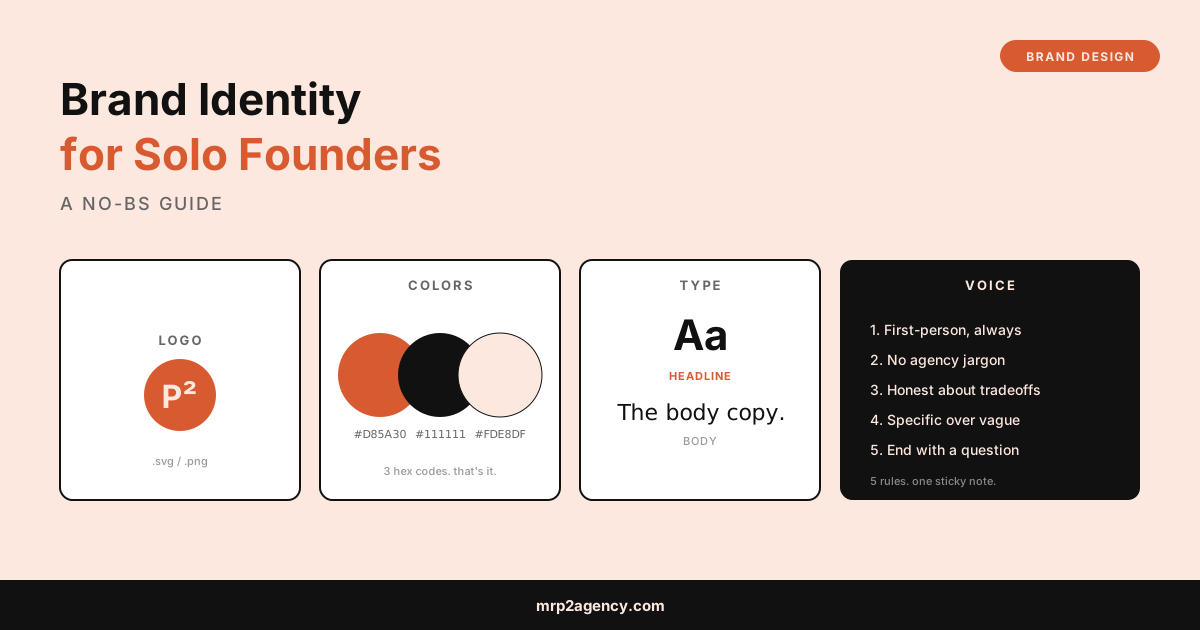
The Minimum Viable Brand Identity for Solo Founders
Forget the 200-page brand book. Here’s everything you actually need on day one:
- One logo, two formats. A horizontal version for navs and headers. A square or stacked version for avatars and favicons. That’s it.
- Two or three colors. A primary, a secondary, and (optionally) an accent. Hex codes written down somewhere.
- Two fonts, max. One for headings, one for body. Often you can get away with one good sans-serif used at different weights.
- Five voice rules. Words you use. Words you don’t. The tone you’re going for in one sentence.
- A logo file in SVG. Not just a PNG. SVG scales, PNG doesn’t, and you’ll regret choosing the wrong format the first time you need a billboard mockup.
That’s a brand identity. Anything beyond it on day one is overkill. You can build the rest as you grow.
Brand Colors for Small Business: How to Pick Them
When you search brand colors for small business, you’ll find a thousand “color psychology” articles claiming blue means trust and red means urgency. This is mostly nonsense. Color associations vary wildly by culture, industry, and context.
Here’s what actually matters:
- Pick a color that doesn’t already belong to your top three competitors. If everyone in your industry is blue, do not be the fourth blue. Differentiate.
- Pick a color that works on light AND dark backgrounds. Pure red and pure yellow fail this test. Coral, teal, deep purple, and forest green all pass.
- Pick a color you’ll still like in three years. Trends die. If you’re picking a color because it looks like every Linear-clone landing page in 2026, you’ll repaint in 2028.
- Test your color in context. Make a fake homepage. Make a fake business card. If it makes you wince, pick again.
For a small business, three colors is usually plenty. A primary (the one people remember), a secondary (usually black or near-black for text), and an accent (used sparingly for buttons and highlights). Coolors is free and will generate complete palettes from a single seed color. So will Adobe’s color tool.
The best brand color is the one your customers can describe over the phone. “The orange site.” “The dark green logo.” If they can’t describe it that simply, it’s not memorable.
Best Fonts for Small Business Websites
The honest answer for best fonts for small business websites: pick from the Google Fonts library, use one or two faces, and move on. Free, fast-loading, and readable on every browser ever made.
A few that almost never go wrong:
| Use case | Font | Why |
|---|---|---|
| All-purpose sans | Inter | Clean, modern, designed for screens |
| Friendly sans | DM Sans | Warm without being cute |
| Editorial / serious | Crimson Pro | Looks expensive, costs nothing |
| Display headlines | Fraunces | Distinctive, lots of weights |
| Code or technical | JetBrains Mono | Best free monospace going |
Rules of thumb:
- One sans-serif for body text, always
- One display font for headings, optional but adds personality
- Never more than two faces on a single page (different weights of the same face don’t count)
- Do not use Comic Sans, Papyrus, or any font with the word “script” in the name
- Body copy at 16 to 18px minimum on web, full stop
If you’re paralyzed by choice, default to Inter for everything and ship the site. You can always upgrade your typography later. Your customers genuinely will not notice unless something is offensively wrong.
Voice Rules That Fit on a Sticky Note
The visual stuff is easy. Voice is where most solo founders blow it.
Write five rules. Tape them to your monitor. Refer to them every time you write a homepage, an email, or a social post.
Mine, for context:
- First-person, always. “I built this,” not “Our team delivers solutions.”
- No agency jargon. Words I refuse to use: leverage, synergy, robust, comprehensive, navigate (as a verb).
- Honest about tradeoffs. If something costs more, say so. If a tool is good but expensive, say that.
- Specific numbers over vague claims. “Loads in 1.2 seconds” beats “blazing fast.”
- End emails with a question, not a closing. Keeps the conversation going.
Yours will be different. The point is having them written down. Voice without rules drifts. You’ll sound like a startup blog one week and a corporate brochure the next.
Your Website Is Your Loudest Brand Asset
A solo founder’s website does more brand work than the logo, the colors, the fonts, and the voice rules combined. If your site is slow, ugly, or built on a template everyone else is using, the brand identity you spent two weeks crafting in Figma evaporates the second a visitor lands.
This is part of why I keep arguing for hand-built websites over page-builder templates when the budget allows. The performance, the customization, the ability to look like nobody else, all of it lives or dies based on the site itself, not the brand book in your Notion.
The Free Brand Guidelines Template
If you want a one-page document to hold all of this, logo files, color hex codes, font choices, voice rules, you don’t need a tool. Make a single Notion page or a Google Doc with these sections:
1. Logo (link to SVG and PNG files)
2. Colors (hex codes + usage notes)
3. Type (font names + where to use each)
4. Voice (5 rules max)
5. Don't (3-5 things to avoid)
That’s the entire brand guidelines template you need. Anyone you hire (a developer, a freelancer, a contractor) can read that page in 90 seconds and immediately produce on-brand work. Anything longer is decoration.
If you want a fancier template, Brandpad and Frontify make hosted brand guideline tools, but they’re built for teams of 20+. For one person, a Notion doc is faster, free, and easier to update.
Rebrand Small Business Checklist: When to Refresh
Most solo founders rebrand too often. They mistake boredom with their own logo for actual customer fatigue. Customers see your logo for three seconds a week. You see it 800 times a day. You will get tired of it before they do.
A real rebrand small business checklist has five honest triggers:
- The business has fundamentally changed (different audience, different product, different positioning)
- You can’t legally use part of the existing identity (trademark issue, contested name, etc.)
- The visual identity is genuinely dated, not just “I’m bored of it” dated
- Customers consistently misunderstand what you do based on the brand alone
- You’re merging or being acquired
If none of those apply, you don’t need a rebrand. You need a polish. Clean up the logo file, update one or two colors, swap fonts. That takes a weekend. A full rebrand takes three months and costs ten thousand dollars in agency hours, even at solo-founder rates.
Where to Start This Week
Block off four hours on a Saturday. In that time you can realistically:
- Pick three colors and write down the hex codes
- Pick two fonts from Google Fonts
- Sketch a logo concept, or hire someone on 99designs for around $400 if drawing isn’t your thing
- Write five voice rules
- Put it all in one Notion doc
That’s a brand identity. It’s not a $25,000 brand identity. It’s a brand identity that fits the size of your business right now, leaves room to grow, and gets you out of paralysis so you can actually go sell something.
Want a real opinion on what your brand should look like in practice, not just in a mood board? Tell me about your project and I’ll give you the honest version.