The fix took six hours spread over two weeks. Within 30 days he was ranking page one for his top five local queries. This is a local SEO checklist for service business owners who want the same outcome without paying an agency $1,500 a month to babysit obvious work.
I’ll keep this practical. Skip the theory, skip the “ranking factors infographic” filler, get to what actually moves the needle when you’re a small service operator trying to dominate your zip code.
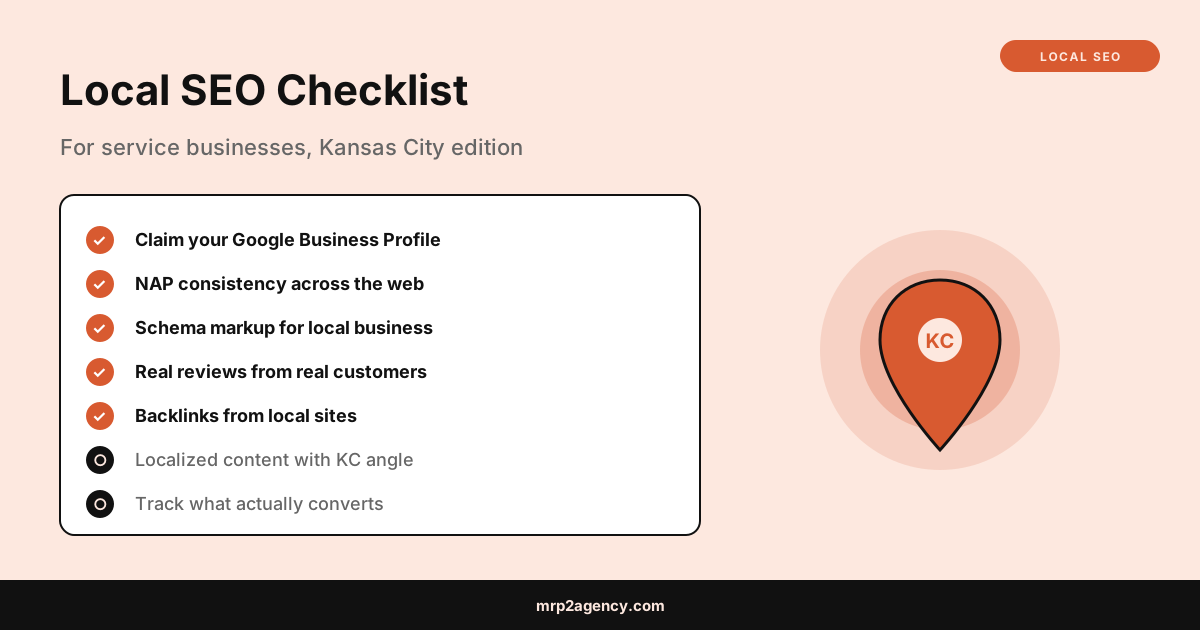
1. Claim and Optimize Google Business Profile
This is 60% of local SEO. Everything else combined is the other 40%. If you do nothing else on this list, do this.
Go to Google Business Profile and claim your listing. Then fill out every field. Not most of them. Every field. Google’s local ranking algorithm uses profile completeness as a signal, and most competitors have half-empty profiles.
Specifically:
- Primary category that matches your main service exactly
- Up to nine additional categories that fit
- All hours, including holiday hours (set them now for the next 12 months)
- Service areas with specific zip codes, not just “Kansas City Metro”
- 10 to 20 photos, refreshed every quarter
- A complete “From the business” section that uses your target keywords naturally
- Services and products with descriptions and prices when possible
- Questions and answers section, populated with the actual questions customers ask
The plumber I mentioned ranked nowhere because his profile had three photos from 2021 and no service areas defined. Fixing that alone moved him into the local pack within three weeks.
2. NAP Consistency Across Every Mention
NAP stands for Name, Address, Phone. Your business has one of each. Google checks the entire web to see if you’ve spelled them consistently everywhere. Variations confuse the algorithm and dilute your local authority.
Audit the top 20 places your business is listed:
- Your own website (header, footer, contact page, schema markup)
- Google Business Profile
- Yelp, Yellow Pages, Bing Places, Apple Maps
- Better Business Bureau if you’re listed
- Industry-specific directories (Houzz for contractors, Avvo for lawyers, Healthgrades for medical)
- LinkedIn company page
- Facebook business page
Pick the exact format you’ll use everywhere and stick to it. “Suite 200” everywhere, never “Ste 200” on one and “#200” on another. Phone format like “(816) 555-1234”, same on every listing.
BrightLocal and Whitespark both have free citation audit tools. Run yours.
3. Schema Markup for Local Business
Most service business websites have zero structured data. Add JSON-LD schema and you get an immediate edge over competitors who haven’t.
The minimum schema for a local service business:
{
  "@context": "https://schema.org",
  "@type": "LocalBusiness",
  "name": "Your Business Name",
  "image": "https://yoursite.com/img/storefront.jpg",
  "address": {
    "@type": "PostalAddress",
    "streetAddress": "123 Main St",
    "addressLocality": "Kansas City",
    "addressRegion": "MO",
    "postalCode": "64105"
  },
  "telephone": "(816) 555-1234",
  "url": "https://yoursite.com",
  "areaServed": "Kansas City Metro Area",
  "priceRange": "$$"
}
Drop that in the <head> of your homepage. Validate it with the Schema.org Markup Validator. Plumbers, contractors, attorneys, dentists, and most other trades have their own subtypes (Plumber, Attorney, Dentist, etc.) which give you even better targeting.
For more on what Google actually does with structured data, see Google’s developer documentation on structured data.
4. Reviews From Real Customers, Continuously
Reviews are a top-three local ranking factor and the single biggest trust signal for prospects. Two specifics that matter most:
Recency. Google weights reviews from the last 90 days more heavily than old ones. A business with 200 reviews from 2022 and nothing since ranks lower than one with 40 reviews and three from last week. Build a workflow that asks every happy customer for a review, every time.
Diversity of platforms. Five-star Google profile is great. Five-star Google plus five-star Yelp plus five-star Facebook plus five-star industry-specific (Houzz, Avvo) is significantly stronger. Pick three or four platforms relevant to your trade and work them all.
Don’t pay for reviews. Don’t post fake ones. Both are detectable and the penalty when Google catches you can wipe out years of work.
5. Backlinks From Local Sites
Local SEO is partly a popularity contest among local websites. You want links from sites that Google already trusts as Kansas City entities.
Easy wins for KC service businesses:
- Local chamber of commerce membership (Kansas City Chamber, Northland Chamber, etc.)
- Local news mentions, especially business sections of KC Star, Startland News, KC Business Journal
- Industry associations with member directories
- BBB listing
- Local nonprofit partnerships where they list sponsors on their site
- Local podcast guest appearances
One link from kansascity.com or a city government domain is worth dozens of generic directory submissions. Quality over quantity, always.
The general approach mirrors what works for SEO for nonprofits and school programs, since both depend on local trust signals.
6. Localized Content That Matches Search Intent
Your homepage and service pages need to mention Kansas City naturally. Not stuffed in 47 times, but present where it makes sense.
A plumber’s homepage should say things like “serving Kansas City and the surrounding metro since 2018” and “Kansas City plumbing repairs, 24/7.” Their service pages should have local language: “drain cleaning in Kansas City,” “water heater installation in Overland Park.”
If you serve multiple neighborhoods, build a page per neighborhood. “Plumber in Brookside” and “Plumber in Waldo” and “Plumber in Lee’s Summit” each get their own page with unique content, not a copy-paste template with the city name swapped.
This is tedious. It’s also how you outrank competitors who only have one homepage that says “Greater Kansas City Area.”
7. Track What Actually Converts
Most service businesses obsess over “how many people visited my site.” That’s not the metric. The metric is how many people called or filled out the form.
Set up:
- Call tracking with CallRail or similar so you know which channel drove which call
- Goal conversions in Google Analytics 4 for form submissions and clicks-to-call
- Google Search Console to see which local queries you rank for
Check these monthly. Cut the channels that don’t convert. Double down on the ones that do. The plumber I mentioned went from 4 leads a month to 22 within four months by doubling down on the local searches that actually drove calls, which Google Business Profile dominated.
What This Means for Your Service Business
If you’re a service business owner in Kansas City, this checklist is the entire system. There is no secret tactic, no shortcut, no $4,000-a-month agency that knows something you don’t. Local SEO is mostly disciplined execution of the seven items above.
Block off two Saturday mornings. Do items 1, 2, and 3 the first weekend. Do items 4 and 5 the second weekend. Items 6 and 7 are ongoing.
If you’re trying to do this while also running your business and you don’t have the time, that’s a reasonable place to hire help. The same selection process applies as in hiring a freelance web developer in Kansas City. Find someone who’ll tell you what they’d actually do, not just sell you a monthly retainer.
Want a real look at your current local SEO? Tell me about your business and I’ll give you an honest read on where the gaps are.