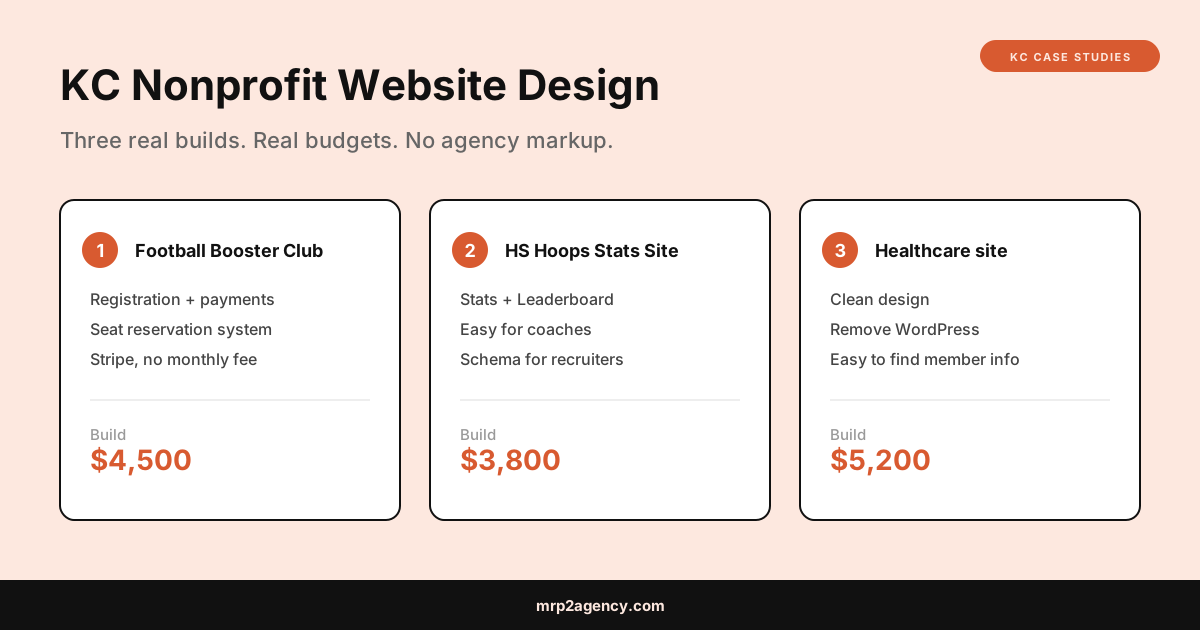
All three are organizations run by people with day jobs and no marketing department. A youth soccer club, a high school basketball program, and a small donor platform. None of them had $30,000 to spend. All three needed something that worked, that they could update without calling me every week, and that didn’t look like a 2011 template.
Here’s what each one needed, what I built, and what I’d tell you if you run something similar in the KC metro.
Why Nonprofit and School Sites Are Different
Before the case studies, the context that shapes every one of these builds. Nonprofit and school websites have constraints that a normal small business site doesn’t:
- No budget for ongoing fees. A $200/month “website maintenance” retainer is a real chunk of a small nonprofit’s annual operating budget. The site has to be cheap to run.
- Volunteer admins. The person updating the site is a parent or a coach, not a developer. If editing a roster requires touching code, it won’t get done.
- Seasonal traffic spikes. Registration opens, tryouts happen, a tournament gets posted, and traffic jumps 10x for a week. The site can’t fall over.
- Trust signals matter more. People are handing over money or their kid’s information. The site has to look legitimate, or donations and signups quietly don’t happen.
Every decision below comes back to those four things. Now the actual builds.
Case Study 1: Kansas City Booster Club Website Design
LN Eagle FC is a youth soccer club. When they came to me, registration was happening over a chain of group texts and a Google Form that nobody could find. Parents were confused, the board was drowning in admin, and the “website” was a single outdated page.
What they needed was less a website and more a lightweight system. The build:
- A clean public site with schedules, team pages, and coach contact info
- An online registration flow that fed directly into a spreadsheet the board could read
- Online payment so parents could pay club fees with a card instead of writing checks
- A news section the board could update themselves
I built the public site as fast static pages and wired registration and payments through Stripe, which keeps per-transaction costs low and has no monthly minimum. Hosting went on a free static tier, so the club’s ongoing cost is basically just Stripe’s percentage on each payment.
Cost: about $4,500 for the build. Ongoing: under $20/month effectively, almost all of it card-processing fees.
The outcome: registration that used to take the board weeks of manual chasing now runs mostly on its own. The lesson that applies to any club: I broke down the full pattern for this kind of project in the lessons from three real booster club builds. The short version is that “website” is usually the wrong word. These orgs need a small app with a simple front door.
Case Study 2: Kansas City High School Website Design
KC HS Hoops is a high school basketball program that wanted a real home online: game schedules, rosters, player highlights, and a way for college recruiters and local press to find current information without emailing a coach.
The constraints here were specific to schools. The coach is the admin, and he has about ten minutes a week to spend on the site. Whatever I built had to be editable from a phone between practices.
The build:
- A fast, mobile-first site (most traffic is students and parents on phones)
- A roster and schedule system the coach updates through a simple editor, no code
- A highlights section that embeds video without slowing the page down
- Schema markup so Google shows the program correctly in search and surfaces upcoming games
That last point matters more than people think. Good structured data is why a program shows up properly when someone searches its name. I went deep on this exact problem in SEO for nonprofits, booster clubs, and school programs, because almost no high school program does it and the ones that do stand out immediately.
Cost: about $3,800 for the build. Ongoing: roughly $15/month for hosting and a video embedding service.
The outcome: the program controls its own narrative now. When a recruiter searches the team, they land on an official page with current rosters and contact info, not a four-year-old MaxPreps stub.
Case Study 3: Kansas City Healthcare Website Design
Team Donor is a small organization in the healthcare and donation space. This was the most sensitive of the three, because the site handles personal information and has to feel completely trustworthy. A janky donation form here doesn’t just look bad, it actively loses donations.
The build focused on credibility and conversion:
- A clear, calm design that prioritized trust over flash
- A donation flow with as few steps as possible (every extra field drops completion)
- Secure handling of donor information with HTTPS everywhere and no sketchy third-party scripts
- Fast load times, because a slow page on a donation ask is money walking out the door
For an organization like this, I also point people toward Google for Nonprofits and TechSoup, which offer discounted or free tools that stretch a tiny budget a long way. Part of the job with nonprofit clients is telling them where not to spend money.
Cost: about $5,200 for the build, the highest of the three because of the trust and security requirements. Ongoing: under $25/month.
The outcome: a donation experience that converts. The single biggest win was cutting the donation form from a multi-page process down to one screen, which measurably increased completed gifts.
What These Three Have in Common
Pull back and the pattern across all three Kansas City nonprofit website design projects is identical:
| Factor | What worked |
|---|---|
| Budget | $3,800 to $5,200, one-time, flat rate |
| Hosting | Static or near-static, under $25/month |
| Admin | Non-technical, phone-friendly editing |
| Payments | Stripe, no monthly minimum |
| Priority | Trust and speed over visual gimmicks |
None of these needed a $20,000 custom platform. They needed a developer who understood the real constraint, which is that the organization has no money to burn and no technical staff. Build for that and the site actually gets used.
What This Means for Your Organization
If you run a nonprofit, a booster club, a school program, or a small healthcare org in the Kansas City area, the takeaway is this: you do not need an agency, and you definitely do not need a recurring four-figure retainer. You need a site sized to your actual constraints and built so your volunteers can run it.
The vetting framework for finding the right person to build it is the same one I laid out for any local hire in hiring a freelance web developer in Kansas City. Ask for examples of work for organizations like yours. Ask what it costs to run after launch. If the answer to that second question is a big monthly number, keep looking.
Want to talk through what your organization actually needs before you spend a dollar? Tell me about your project and I’ll give you a straight read, even if the honest answer is that a simpler tool would serve you better than a custom build.