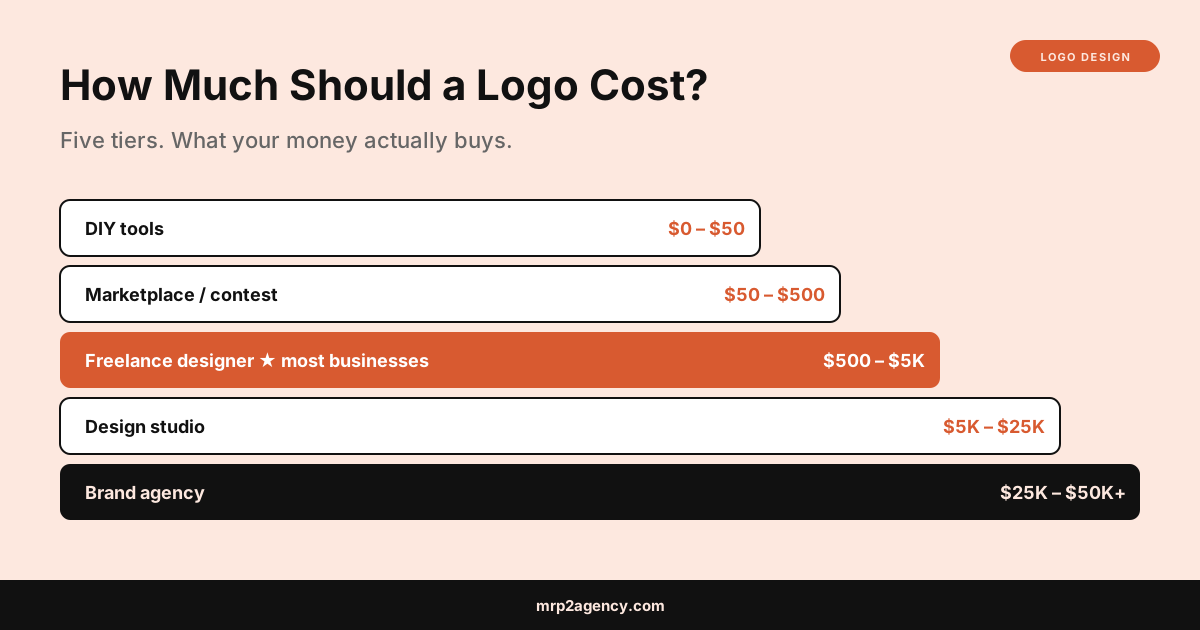
So here are the tiers. Real 2026 numbers, what you get at each one, and the part nobody tells you: most small businesses are buying at the wrong level, in both directions. Some overpay an agency for a mark a freelancer would have nailed. Others go too cheap and end up rebranding in a year.
Let me break down what your money actually buys.
The Five Price Tiers
There are roughly five tiers of logo, and the jump between them is about who makes it and how much thinking goes in, not how the final file looks.
| Tier | Who | Cost | Best for |
|---|---|---|---|
| DIY tools | You + software | $0 to $50 | Testing an idea, side projects |
| Marketplace / contest | Anonymous designers | $50 to $500 | Tight budgets, simple needs |
| Freelance designer | One pro | $500 to $5,000 | Most small businesses |
| Design studio | Small team | $5,000 to $25,000 | Funded startups, regional brands |
| Brand agency | Full agency | $25,000 to $50,000+ | National brands, big budgets |
Those are honest ranges. Now what’s actually different about each.
Tier 1: DIY Tools ($0 to $50)
Canva, Looka, and a dozen AI logo generators will produce a usable mark in an afternoon. For a side project, a soft launch, or testing whether a business idea has legs, this is genuinely fine.
The catch: these tools work from templates, so your logo will resemble thousands of others, and you rarely get the full file formats or usage rights a real brand needs. Use this tier to start, not to finish. If the business takes off, budget to redo it.
Tier 2: Marketplace and Contest Sites ($50 to $500)
Sites like Fiverr and 99designs let you buy a logo from freelancers around the world, often through a “contest” where many designers submit and you pick one.
You can get something decent here. You can also get a logo that was quietly copied from a stock library, which becomes your problem later. The work is fast and cheap because there’s almost no discovery, no strategy, and no real revision relationship. For a simple, low-stakes business, it’s a reasonable gamble. Just run the final mark through a reverse image search before you commit to it.
Tier 3: Freelance Designer ($500 to $5,000)
This is where most small businesses should be, and it’s the tier I usually steer clients toward. A good freelance designer gives you an actual person who asks about your business, your customers, and your competitors before drawing anything.
What you get for the money:
- A short discovery conversation about your brand
- Two to four real concept directions, not fifty random thumbnails
- A couple of revision rounds on the direction you pick
- Final files in every format you need (vector, web, print, light and dark versions)
- Clear ownership and usage rights
At the lower end of this range you’re getting a logo. Toward the top you’re getting closer to a small identity system. Which brings up the thing people constantly confuse.
Logo Design vs Brand Identity
A logo is one piece of a brand identity, not the whole thing. This is the single most expensive misunderstanding in this entire topic.
A logo is the mark. A brand identity is the logo plus your colors, typography, the way photos are treated, the voice, and the rules for using all of it consistently. When an agency quotes you $30,000, they are almost never quoting a logo. They’re quoting an identity system, and the logo is maybe 15% of that work.
So before you balk at a price, find out what’s actually included. A $4,000 quote that includes color palette, fonts, and a basic usage guide is a different product than a $4,000 quote for a single logo file. I broke down the full minimum-viable version of this in brand identity for solo founders, which is the cheaper, sane starting point for most people.
Tier 4 and 5: Studios and Agencies ($5,000 to $50,000+)
Design studios and full agencies earn their fees on big, complex brands where consistency across dozens of touchpoints genuinely matters. National rollout, multiple sub-brands, packaging, environmental design, the works.
For a typical small business or local service company, this tier is overkill. You are paying for account managers, strategists, and a 60-page brand book you will open twice. There’s nothing wrong with the work. It’s just priced for a problem you probably don’t have. The same logic applies to websites, which I covered in how much a custom website costs in 2026: the middle tier is almost always the right answer, and the top tier is usually buying you overhead.
The Logo Design Process Explained
Whatever you pay, a real process looks roughly the same. Knowing the steps helps you tell a real designer from someone just exporting a template.
- Discovery. Questions about your business, audience, and competitors. If this step is skipped, you’re not getting design, you’re getting decoration.
- Concepts. A few distinct directions, usually in black and white first so you judge the idea, not the color.
- Refinement. You pick a direction and it gets sharpened over one or two revision rounds.
- Color and variations. Final colors, plus versions for dark backgrounds, tiny sizes, and single-color printing.
- Delivery. Every file format you’ll need, ideally with simple usage notes.
If a quote doesn’t mention discovery or revisions, that’s a flag the price is too good because the thinking isn’t included.
Minimalist Logo Design Tips
One reason the best logos cost more is that simple is hard. A few principles that hold up regardless of budget:
- It has to work in one color. If it falls apart in plain black, it’s too complicated.
- It has to work tiny. Your logo will live as a favicon and an app icon. Detail that disappears at 32 pixels is wasted.
- Avoid trendy effects. Gradients and 3D bevels date fast. Clean shapes last.
- No clip art. A generic icon you’ve seen on ten other businesses is worse than a clean wordmark of just your name.
A plain, well-set wordmark beats a cluttered “icon plus text” logo almost every time, especially for small businesses that need to look established and trustworthy fast.
What This Means for Your Budget
If you’re a small business owner or solo founder, here’s the honest framework: for most of you, budget $500 to $3,000 and hire one good freelancer. Go cheaper only if it’s a side project you’re testing. Go more expensive only if you’re funded and rolling out across many channels at once.
Whatever you spend, make sure you actually own the result and you get every file format. The most common way people get burned isn’t the price, it’s paying for a logo and walking away without the vector source files, then having to pay again to recreate them.
Not sure which tier you actually need, or whether you need a full identity instead of just a mark? Tell me about your project and I’ll give you a straight recommendation, even if it’s “spend less than you think.”