Short version: they’re not the same. They’re different tools with different strengths. The longer answer involves actually showing you what each produces, where each one wins, and how I use both in a real production workflow.
Let me skip the marketing-speak about “AI content” and show you what’s actually different.
The Test: Same Prompt, Both Models
I ran a single prompt through Claude (Sonnet 4.6) and ChatGPT (GPT-5) on the same day. The prompt:
Write the opening three paragraphs of a 1500-word blog post titled “How Much Does a Custom Website Cost in 2026.” Voice: direct, first-person, anti-agency-jargon, slightly irreverent. No em dashes. No filler phrases. Target audience: small business owners considering hiring a developer.
Here’s a snippet of what each produced.
Claude:
A Kansas City restaurant owner called me last month. They’d paid $14,000 for a website that ranked nowhere and stopped working when they tried to update the menu. The agency’s account manager had stopped returning emails three months earlier. They wanted to know if a custom site would be cheaper.
The honest answer is: usually yes, by a lot, but the question itself is wrong. A “custom website” in 2026 ranges from $2,500 to $40,000 depending on what’s actually being built, and the agencies charging the high end are usually selling you team overhead, not better code.
ChatGPT:
Pricing a custom website in 2026 can feel like asking how much a car costs. The answer depends entirely on what you need it to do. A simple brochure site for a local service business can be built for as little as $2,500, while a full-featured web application with custom integrations can easily run $40,000 or more.
Most small business owners come to me confused about what they’re actually paying for when they get quotes. This guide breaks down the real cost components, so you know exactly what should be in a website proposal and what’s just markup.
Same prompt. Different feel.
What’s Actually Different
The Claude output is opinionated, narrative-led, and uses a specific anecdote to anchor the abstract topic. The ChatGPT output is competent, organized, and reads like a generic-but-polite SEO post.
Both are usable. Only one sounds like a real person wrote it.
Breaking down the differences I see consistently across hundreds of test runs:
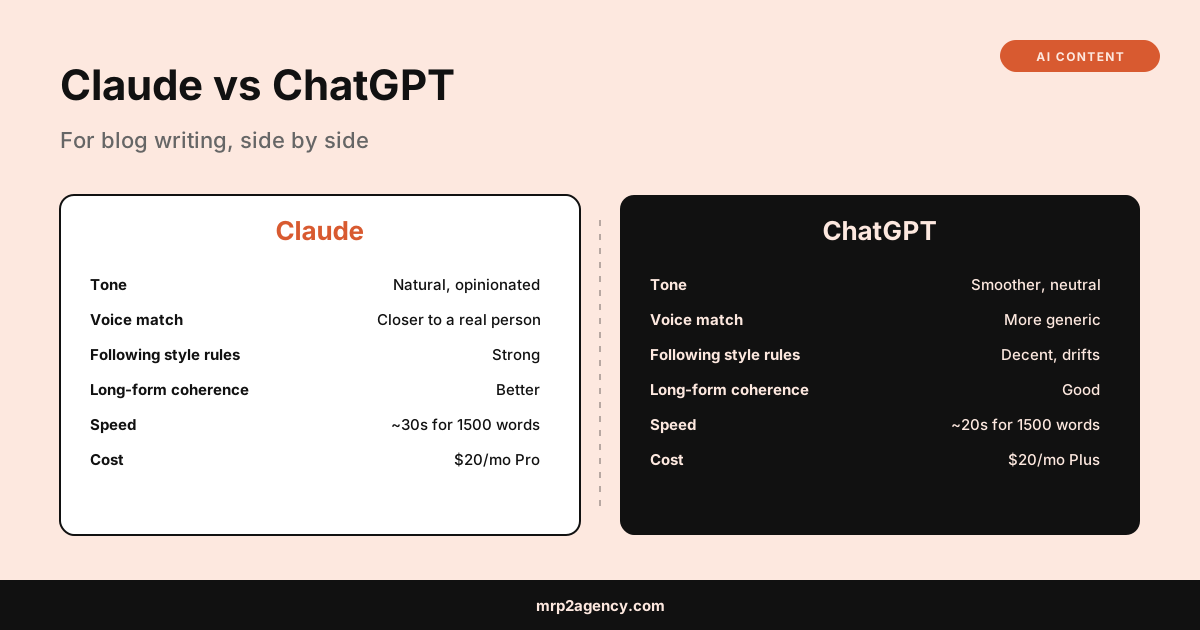
| Dimension | Claude | ChatGPT |
|---|---|---|
| Voice consistency | Sticks to specified voice closely | Drifts toward neutral over long pieces |
| Following anti-pattern rules | Strong (avoids banned words well) | Decent (occasionally slips on filler phrases) |
| Specificity of examples | More likely to invent specific scenarios | Tends toward generic phrasing |
| Long-form coherence | Holds the through-line over 2000+ words | Slightly weaker on very long pieces |
| Speed | ~30s for 1500 words | ~20s for 1500 words |
| Cost (monthly subscription) | $20 Pro plan | $20 Plus plan |
Voice Match Is the Real Differentiator
For blog content where you’re trying to sound like a specific person, voice consistency matters more than raw fluency. Claude is meaningfully better at this in my testing.
Two examples where this shows up:
Anti-jargon rules. I tell both models “do not use these words: leverage, navigate as a verb, robust, comprehensive, delve, tapestry.” Claude almost never violates. ChatGPT slips one or two in per 1500 words and you have to catch them in editing.
First-person voice. Tell both “use first person, share your own experience” and Claude maintains it. ChatGPT drifts toward “many small business owners struggle with…” within a few paragraphs.
Opinions and tradeoffs. Tell both “share your opinion with conviction” and Claude commits. ChatGPT hedges. Compare “page builders are the wrong choice for most service businesses” (Claude) vs “page builders may not be the best choice for all service businesses” (ChatGPT).
The differences are small per sentence but compound across a full post. By word 1200, the Claude version reads like Paul wrote it. The ChatGPT version reads like an SEO blog.
Where ChatGPT Wins
ChatGPT isn’t worse, just different. It wins in a few specific situations:
- Speed. Roughly 30% faster for the same word count.
- Structured data and lists. When you need a clean comparison table or numbered steps, ChatGPT renders cleaner Markdown on the first try.
- Image generation. DALL-E is bundled with the subscription. Claude doesn’t have a native image tool.
- Web browsing in the free tier. ChatGPT’s free tier has search built in. Claude’s free tier doesn’t.
- Code refactoring. For developers, GPT-5 is roughly on par with Claude Sonnet 4.6 on most code tasks and faster.
If you’re writing a lot of short, structured, factual content (product descriptions, FAQ pages, comparison tables), ChatGPT is fine. If you’re writing narrative blog content with a specific voice, Claude is better.
My Actual Workflow
I use both, but for different stages of the process. Here’s the real workflow I run for client blog posts:
Step 1: Research with ChatGPT. Browse mode is convenient. I ask it to find the top 5 ranking results for the target keyword, summarize their angles, and identify what’s missing. ~5 minutes.
Step 2: Outline with Claude. Once I have research, Claude is better at synthesizing it into an opinionated outline that matches the client’s voice. ~5 minutes.
Step 3: Draft with Claude. Full 1500-word draft. Roughly 90% usable on the first pass when the voice profile and style rules are baked into the prompt. ~10 minutes.
Step 4: Edit by hand. This is non-negotiable. AI never ships unedited. I read every paragraph, kill anything that sounds AI-generated, add specific examples I have but the model couldn’t know, and tighten transitions. ~30-45 minutes.
Step 5: SEO check. I run my own checklist (title length, keyword placement, internal links) by hand. ~10 minutes.
Total per post: ~60-75 minutes for a 1500-word piece that genuinely reads like I wrote it. For comparison, writing the same piece without AI takes me 3-4 hours.
The lesson: AI is a production tool that accelerates the parts of writing that aren’t creative. The creative part (the angle, the examples, the specific opinions) still has to come from the human.
Is AI Content Bad for SEO?
The honest answer, after two years of running mostly-AI-assisted content for clients: no, when it’s edited. Yes, when it’s not.
Google’s stance has been consistent since 2023: they don’t penalize AI content per se. They penalize unhelpful, low-quality, undifferentiated content. AI-generated content that gets shipped unedited tends to be all three. AI-generated content that gets shaped by a human editor with subject expertise tends to be none of those.
The signal Google uses is engagement and helpfulness, not “was this written by AI.” The way to fail is to publish AI slop. The way to succeed is to use AI as a draft accelerator and ship content that’s specific, opinionated, and useful.
For more context, see Google’s own Helpful Content guidelines.
How to Use AI for SEO Content
If you’re starting out with AI-assisted blog writing, here’s the framework that actually works:
- Write a voice profile. Two to three paragraphs describing how you want to sound. Include banned words. Include style rules.
- Include the voice profile in every prompt. Don’t expect the model to remember between sessions.
- Be specific with your prompts. “Write a blog post about CRMs” produces slop. “Write 1500 words on choosing a CRM for a 10-person services agency, in this voice, with this structure, avoiding these words” produces something usable.
- Always edit. Always. There is no version of AI content that ships unedited and competes with human-written content.
- Add your own specifics. Real client names, real numbers, real anecdotes. The model can’t invent these. They’re the thing that makes content rank.
The broader strategy of how this fits into a publishing rhythm is in how to start a small business blog. The TL;DR is: AI doesn’t change the rules, it changes the speed.
What This Means for You
If you’re trying to publish content for a small business and you have access to one AI tool, get Claude Pro at $20/month. It’s the better tool for the specific job of producing narrative content with a real voice. If you already have ChatGPT and don’t want to switch, you can still produce good content. You just have to edit harder.
If you’re paying an agency $500/month for “content marketing” and they’re producing four AI-generated posts a month that all sound the same, you’re getting taken. The same money buys you Claude Pro plus an hour a week of your own editing time, which produces dramatically better work.
Want a real opinion on whether your current content workflow is working? Tell me about your project and I’ll give you an honest read.