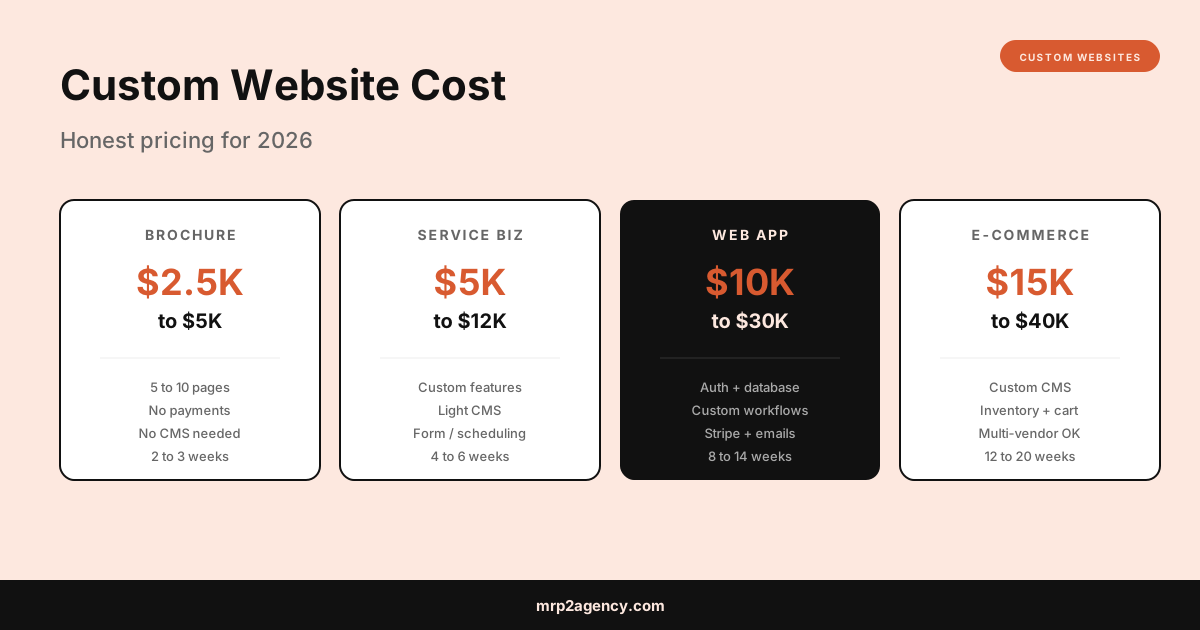
How much does a custom website cost in 2026 is one of the most-asked questions in small business marketing, and almost every answer online is either an agency landing page or a freelancer trying to anchor you to their preferred number. Here’s what I tell clients, in real ranges, with what’s actually included and what gets added later.
I’ve quoted hundreds of these. The pattern is consistent. Let me show you the real numbers.
The Four Tiers
There are roughly four tiers of “custom website” that real businesses buy. Each has a real cost range based on what’s actually being built, not what the agency wants to charge.
| Tier | What it is | Real cost | Timeline |
|---|---|---|---|
| Brochure | 5 to 10 static pages, no payment processing | $2,500 to $5,000 | 2 to 3 weeks |
| Service business | Custom features, light CMS, forms, scheduling | $5,000 to $12,000 | 4 to 6 weeks |
| Web app | Auth, database, custom workflows | $10,000 to $30,000 | 8 to 14 weeks |
| Custom e-commerce | Cart, inventory, payment processing, custom CMS | $15,000 to $40,000 | 12 to 20 weeks |
Those are honest 2026 numbers from someone who actually quotes them, not aspirational ranges from an agency selling you “premium positioning.”
What Actually Drives Price
The price of a custom website is determined by four things, in this order of impact:
1. Scope. Number of pages, number of features, complexity of integrations. This is 60% of the price. A 10-page brochure site is genuinely an order of magnitude cheaper than a 200-page e-commerce build, and no amount of “we’re efficient” agency language changes that.
2. Custom integrations. Every API connection, every webhook, every “let’s pull data from this third-party system” adds hours. Connecting to Stripe for payments is 2 to 4 hours. Connecting to a legacy accounting system over a weird FTP protocol is 20 to 40 hours.
3. Design complexity. Templated designs are cheap. Fully custom branded designs cost 2 to 4x more. Sometimes that’s worth it. Often it isn’t. A clean templated design done well is better than a custom design done poorly.
4. Who’s doing the work. A senior freelance developer charges $100 to $200 per hour. An agency with project managers, account managers, and overhead charges $200 to $400 per hour effectively. Same code, 2x the cost.
Where you actually save money is by being honest about scope and by hiring directly. The page builder vs custom code decision tree covers when “custom” is the wrong word entirely.
What’s NOT in Most Quotes
This is where the surprises live. Most quotes leave out things you absolutely need and that get added as “additional scope” later. Watch for these:
- Copywriting. Most quotes assume you provide all text. If you can’t, expect $100 to $300 per page extra for written content.
- Photography. Stock photos vs. real photos make a huge visual difference. Custom photoshoot is $500 to $2,500.
- Logo or brand design. If you don’t have a logo, that’s a separate project. $400 to $5,000+ depending on who you hire.
- Hosting and domain. Often quoted as “your responsibility.” Budget $15 to $50 per month for hosting plus $15 per year for the domain.
- SSL certificate. Usually free now via Let’s Encrypt, but some agencies still charge $200/year. Refuse.
- Email setup. Setting up business email like [email protected] is its own thing. $5 to $15 per mailbox per month with Google Workspace or similar.
- Ongoing maintenance. Bug fixes after launch, plugin updates, security patches. Usually $50 to $200 per month for a small business site.
- Analytics and tracking setup. Google Analytics 4 plus Search Console plus conversion goals. Sometimes included, often not. 2 to 4 hours of work.
- Training. Time to teach you or your team how to update the site. Often charged separately, $100 to $200 per hour.
Add these up and the “true cost” of a $5,000 quote can easily be $7,500 to $9,000 the first year. Get them in writing before you sign anything.
Flat Rate vs Hourly
Almost every agency quotes “time and materials” or “hourly rate.” Almost every solo freelancer worth hiring quotes a flat rate.
The reason: flat rate aligns incentives. The faster I finish, the more profitable the project is for me. Hourly billing aligns incentives the opposite way. The longer it takes, the more they bill.
A reasonable flat-rate quote covers:
- Defined deliverables (number of pages, specific features)
- Two rounds of revisions during design
- One round of revisions during development
- One week of post-launch bug fixes
- A specific launch date
Anything outside that scope is genuinely new work that should be quoted separately. The agency-speak phrase for this is “scope creep.” For solo freelancers, it just means “we’ll quote that as a small additional project.”
I prefer flat rate as a buyer too. I’d rather know what I’m spending. Most clients feel the same.
Red Flags in Pricing
A few patterns that mean you’re getting taken:
“It depends” with no follow-up questions. A good freelancer or agency will ask specific scope questions before quoting. “How many pages? What features? What’s the deadline? Who provides content?” If you get a price without that, the price is fiction.
Prices that anchor high then drop dramatically. A $25,000 quote that becomes $12,000 if you “sign today” was never $25,000. The actual price is whatever the floor is.
Recurring license fees for things that should be one-time. Some agencies build the site on their proprietary platform and charge you $500/month to keep using it. You don’t own anything. Walk away.
Monthly retainers buried in the contract. A site quote that “includes” a $1,500/month maintenance retainer for 24 months is a $36,000 commitment, not a $14,000 project.
“Premium support” or “priority response” upsells. You should already have responsive support included. Paying extra for someone to return your emails is a scam.
Vague scope with phrases like “fully custom” and “tailored solution.” Specific scope. Specific features. Specific deliverables. If they can’t describe what they’re building, they don’t know either.
The general selection framework from hiring a freelance web developer in Kansas City applies. If you wouldn’t trust them to fix your car for a fixed price, don’t hire them to build your website.
Freelance vs Agency Web Developer
The economic difference, plain English:
| Factor | Freelance | Agency |
|---|---|---|
| Hourly rate | $100 to $200 | $200 to $400 effective |
| Communication | Direct to builder | Through account manager |
| Decision speed | Hours | Days |
| Project manager overhead | None | 15 to 30% of project |
| Liability and insurance | Limited (LLC) | Higher (corporate) |
| Best for projects under $20K | Almost always | Rarely |
| Best for projects $30K+ | Usually still | Sometimes |
| Best for projects $50K+ | Sometimes | More often |
For small business sites under $20,000, a freelance developer is almost always the better economic choice. Agencies make sense when:
- You’re spending $50K+ and need four people working in parallel
- You need design, video, and code work bundled
- Your procurement department requires enterprise vendor onboarding
Outside those cases, freelance is faster, cheaper, and more honest.
A Realistic Example
For the Kansas City accounting firm I mentioned at the start, here’s what each quote was actually pricing:
- $2,800 quote: Template site on Wix, no custom code, no SEO setup, no analytics, no copywriting, no training. They’d ship in a week. The site would work, ranking would be flat for years.
- $14,000 quote: Mid-tier agency, custom design, basic CMS, SEO setup, content help, training. Reasonable for what was offered.
- $42,500 quote: Large agency with account manager, project manager, designer, two developers, QA tester. Same final product as the $14,000 quote, plus an enterprise feel and a 30-page proposal document.
The $14,000 was the right answer. The $2,800 would have undercut their SEO for years. The $42,500 was paying for the agency’s office in Leawood, not for better code.
What This Means for You
If you’re a small business owner getting quotes, here’s the honest framework:
- Define your scope before you ask for quotes. Number of pages, specific features, content who’s providing, integrations needed. Write it down.
- Ask three to five providers. Mix freelance and agency.
- Compare scope, not just price. A cheap quote that excludes copywriting and SEO setup isn’t actually cheaper.
- Pick the second-lowest qualified quote. Cheapest is usually too cheap. Most expensive is usually agency overhead. The middle is usually right.
If you’d like a sanity check on a quote you’ve received, send me the proposal and I’ll give you a straight read on whether you’re getting fairly priced work or being marked up.