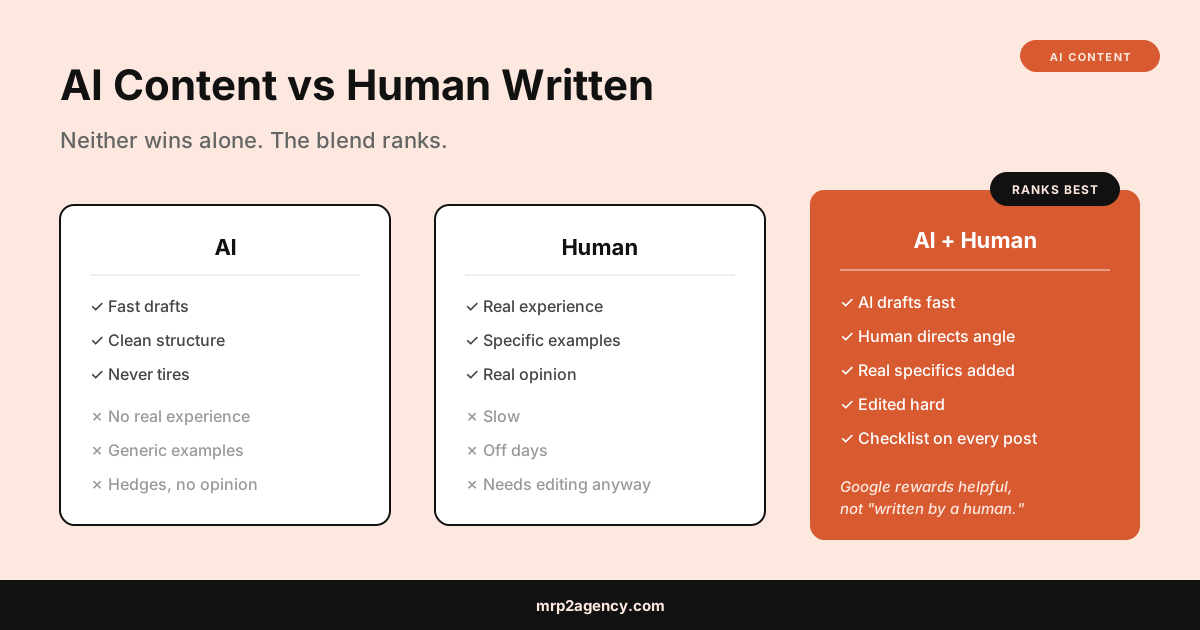
Let me be specific about why, because there’s a lot of confident nonsense on both sides. One camp says AI content is spam that Google punishes. The other says AI replaced writers. Both are wrong, and the gap between them is where the actual opportunity is.
Does Google Penalize AI Content?
Straight answer: no, not for being AI. Google has been clear and consistent on this since 2023. Their guidance about AI-generated content says quality is what matters, not how the content was produced.
What Google actually penalizes is unhelpful, low-quality, undifferentiated content. The problem is that content churned out by AI with no human involvement tends to be exactly that: generic, thin, and the same as a thousand other pages. So AI content gets penalized often, but not for being AI. It gets penalized for being bad.
The distinction matters because it tells you exactly how to use AI without getting burned: use it to produce content that’s genuinely helpful, specific, and differentiated, and you’re fine. Use it to mass-produce filler, and you’ll get what mass-produced filler deserves.
Is AI Content Bad for SEO?
Only when it’s unedited. Here’s the pattern I see across client sites.
AI content that ranks has been shaped by a human with actual subject expertise. Real examples, real opinions, real specifics the model couldn’t have known. It reads like a person who knows the topic wrote it.
AI content that tanks got generated from a thin prompt and published as-is. It’s technically correct, grammatically clean, and completely forgettable. It has no point of view, no specifics, and nothing a reader can’t get from ten other pages.
Google’s ranking systems are built around helpfulness signals, spelled out in its helpful content guidance. Those signals, whether people find the page useful and stay, don’t care how the draft was created. They care whether the final page is worth reading.
AI vs Human Writing Quality: Where Each Wins
Set SEO aside for a second and just compare the writing. Each side has real strengths.
| Dimension | AI writing | Human writing |
|---|---|---|
| Speed | Minutes for a full draft | Hours |
| Consistency | Never has an off day | Varies with energy |
| Structure and grammar | Clean on the first pass | Needs editing |
| Real experience | Can’t have any | The whole advantage |
| Specific examples | Invents generic ones | Draws on what actually happened |
| Point of view | Hedges by default | Can commit to an opinion |
Read that table and the workflow writes itself. Let AI do the parts it’s good at, speed, structure, first-draft grammar, and let the human do the part only a human can: the experience, the specifics, and the opinion. I compared the actual tools for the drafting half of this in Claude vs ChatGPT for blog writing, where the whole test was which one needs less human repair.
What Actually Ranks: The Blend
The content that wins in 2026 isn’t AI or human. It’s a human using AI as a production tool. Here’s what that looks like in practice.
- AI drafts, human directs. The angle, the argument, and the examples come from the human. AI turns that into clean prose fast.
- The human adds what the model can’t know. Real client numbers, real anecdotes, a genuine opinion with conviction. This is the part that makes a page rank, because it’s the part nobody else has.
- The human edits hard. Every AI tell, every hedge, every generic sentence gets cut or sharpened. Nothing ships as generated.
- A checklist enforces the basics. The on-page fundamentals get run every time, which I turned into a blog post SEO checklist so nothing slips.
This produces content faster than pure-human and far better than pure-AI. For a small business, that combination is the whole game: you get the output volume you couldn’t afford otherwise, without the quality drop that gets you ignored.
How to Spot the Difference (and Why Detectors Don’t Matter)
People ask about AI detectors like Originality.ai. Skip the anxiety. Detectors are unreliable, they flag human writing as AI and miss edited AI constantly, and more importantly, Google isn’t running your content through one to decide rankings. Nobody credible is optimizing for “fool the detector.”
The signals that actually reveal lazy AI content are the ones readers feel: no specific examples, no real opinion, a weirdly even tone, and sentences that say nothing wrong and nothing memorable. Fix those and it doesn’t matter what a detector thinks, because the content is genuinely good.
What This Means for You
If you run a small business and you’re wondering whether to use AI for content, the answer is yes, with a hard requirement: edit everything and add your own expertise. AI is the cheapest way to get to a solid first draft you’ve ever had. It is not a way to skip the thinking.
The businesses that lose with AI are the ones that treat it as a publish button. The ones that win treat it as a very fast junior writer whose work always needs a knowledgeable editor. If you want the full system for turning that into a steady publishing habit, it’s in how to start a small business blog.
Want an honest read on whether your content workflow is helping or quietly hurting you? Tell me about your project and I’ll tell you straight.